Improving external quality assurance (EQA) testing through automation

With the aim of eliminating manual processes for quality assurance testing in Australian laboratories, healthcare interoperability company X-Lab partnered with RCPAQAP (Royal College of Pathologists of Australasia Quality Assurance Programs) and Sonic Healthcare Australia Pathology. Implementing X-Lab’s LabgnosticEQA, the partnership was geared towards improving accuracy, efficiency and regulatory compliance across external quality assurance (EQA) testing.
As X-Lab explains, EQA — the independent mechanism by which pathology laboratories benchmark their performance against peer labs and international reference standards — is a cornerstone of patient safety and accreditation compliance, and yet for most laboratories, the EQA process has remained manual; quality assurance program (QAP) tests are typed into Laboratory Information Systems (LIS) by hand, and results are then transcribed into the EQA supplier portal.
Manual EQA creates a fundamental contradiction, X-Lab said. “Patient testing in modern laboratories is conducted electronically — yet EQA, the process designed to assess that testing, is done manually. The result is a compliance gap that places laboratories at odds with ISO 15189, the international standard for medical laboratory quality”, something which explicitly requires that QAP samples must be tested in the same, or similar, manner as patients’ samples, X-Lab added.
“Manual EQA fails to replicate the routine process it is meant to assess,” said Michelle Frazer, Director APAC at X-Lab. “Every transcription step is an opportunity for error — and an error in quality assurance has implications that extend well beyond the EQA program itself. It can mask issues that affect patient care.” LabgnosticEQA is designed to create a fully electronic workflow between EQA providers and laboratories — from order intake through to result submission — closely mirroring the electronic process used for routine patient testing.
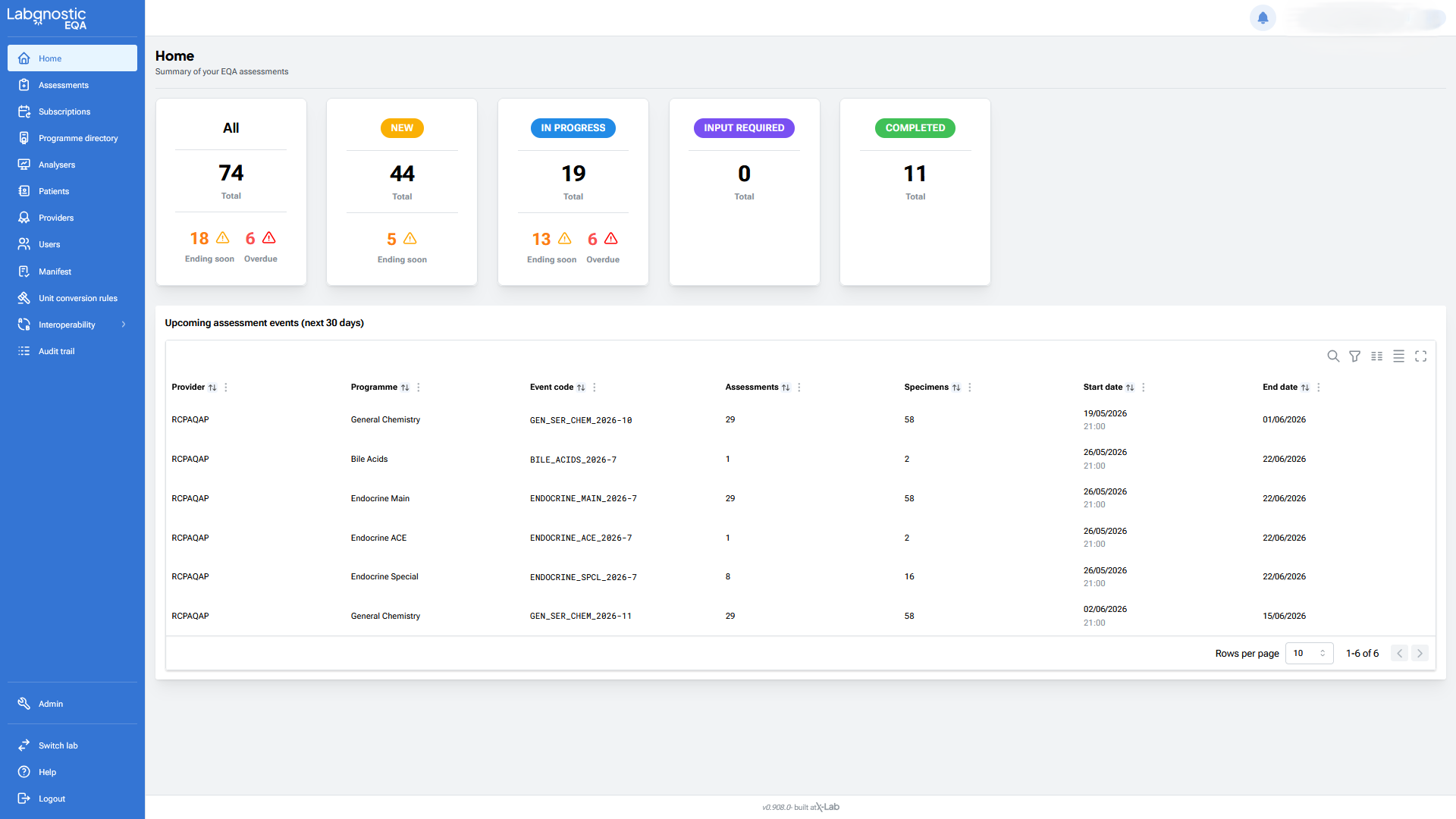
Interfacing with each organisation’s existing systems, the system-agnostic platform is engineered to translate data into the required format and deposit it directly into the relevant platforms. A single connection from the laboratory LIS to the LabgnosticEQA network is sufficient to automate EQA programs across all laboratories and all departments within an organisation, X-Lab said.
For the partnership, X-Lab built dedicated interfaces for RCPAQAP’s MyQAP portal, Labware LIS, and Sonic’s Apollo LIS. An AI mapping tool aligned each organisation’s test and result codes to the LabgnosticEQA framework. Laboratories then selected which subscriptions to automate from a central dashboard. RCPAQAP conducted an audit of automated submissions against manually entered results, assessing both accuracy and submission timing. X-Lab reports that RCPAQAP’s audit found zero data entry errors and missed or late submissions, a reduction from 23 to 3 days in time to first-round submission, and a reduction from 9 to 3 days in average submission time.
Sonic Healthcare Australia Pathology evaluated the solution across a broader range of operational metrics, X-Lab said. These metrics included manual effort, turnaround speed, data accuracy, paper usage, cost and staff satisfaction. X-Lab said that key findings from Sonic Healthcare Australia Pathology’s evaluation were: 85% reduction in manual effort, double the programs processed in half the time, zero data errors, 400% productivity gain, no incorrect, missed or late submissions, at least two fewer sheets of paper per test, average 73% cost reduction, and measurably improved staff satisfaction.
“This implementation demonstrates what becomes possible when EQA is treated as an integral part of the laboratory’s electronic workflow rather than a manual process that sits outside it,” Frazer said. “The gains are not incremental. They represent a fundamental shift in what laboratories should expect from their quality assurance programs.”
Phone:
Vi-CELL BLU 2.0 Viability Analyzer Software
The software enables laboratories to modernise cell viability workflows while maintaining data...
MBF Bioscience Stereo Investigator AI 3D stereology software
Stereo Investigator AI by MBF Bioscience combines unbiased stereology with deep-learning...
Bruker Acquifer HIVE high-performance data management and computing platform
Bruker's Acquifer HIVE is a high-performance, modular data management and computing platform...