Are lab gloves leading scientists to overestimate microplastics?
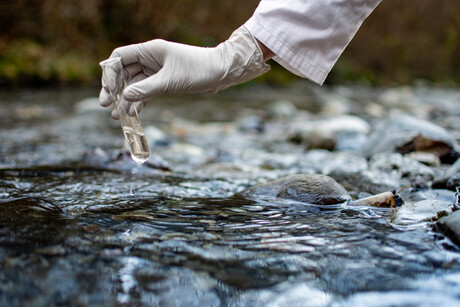
Nitrile and latex gloves worn by scientists measuring microplastics may lead to a potential overestimation of the tiny pollutants, a US study published in March suggests.
Gloves may unintentionally contaminate lab equipment scientists use to measure microplastics in air, water and other samples with non-plastic particles called stearates, researchers Madeline Clough and Anne McNeil from the University of Michigan have suggested — recommending that cleanroom gloves, which release fewer particulates, should be worn instead.
Manufacturers coat disposable gloves with stearates — which are salts, or soap-like particles — to make them easier to peel from the moulds used to form them. But stearates are also chemically similar to some microplastics, according to the researchers, and can lead to false positives when researchers are looking for microplastic pollution.
Clough led the research, published open access (doi.org/10.1039/D5AY01801C) in Analytical Methods, which began while working on another project. On that other project, while Clough prepared the substrates wearing nitrile gloves — as is recommended by the guidance of literature in the microplastics field — she examined the substrates to estimate how many microplastics she captured, and the results were many thousands of times greater than what she expected to find.
“It led to a wild goose chase of trying to figure out where this contamination could possibly have come from, because we just knew this number was far too high to be correct,” Clough said. “Throughout the process of figuring it out — was it a plastic squirt bottle, was it particles in the atmosphere of the lab where I was preparing the substrates — we finally traced it down to gloves.”
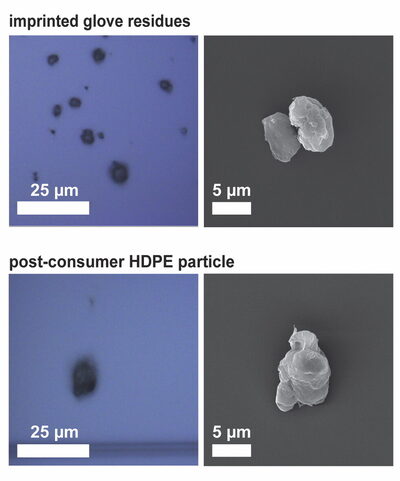
To determine how widespread the problem is, the researchers designed an experiment that tested seven different kinds of gloves. These included nitrile, latex and cleanroom gloves, as well as the most common techniques that microplastic researchers are using to identify microplastics. Mimicking the type of contact that would occur in a research environment between a researcher’s gloved hand and a point of contact, this included a filter or a microscope slide — any piece of technology that a researcher might use over the course of investigating microplastics.
What they found was that, on average, the gloves imparted about 2000 false positives per millimetre squared area. “The type of contact we tried to mimic touches upon all varieties of microplastics research,” Clough said. “If you are contacting a sample with a gloved hand, you’re likely imparting these stearates that could overestimate your results.” Cleanroom gloves were found to impart the fewest particles, likely because cleanroom gloves are manufactured without the stearate coating, allowing them to be used in ‘ultrapure’ applications.
The study, the researchers said, highlights the importance of chemistry researchers in the field of microplastics, who might be able to recognise the difference in chemical structure of plastics versus other contaminants. “This field is very challenging to work in because there’s plastic everywhere,” McNeil said. “But that’s why we need chemists and people who understand chemical structure to be working in this field.”
Newly created antivenom protects against 19 deadly snakes
By using antibodies from a human donor with a self-induced hyper-immunity to snake venom, US...
Antimicrobial coating for sanitary fabrics inspired by mussels
The innovative material fights against the spread of pathogens and antimicrobial resistance,...
Staying compliant: how lab scrubs meet industry regulations and standards
Australian companies involved in any lab work have to see to it that their lab scrubs meet...