Newcastle professor wins international mineral processing award
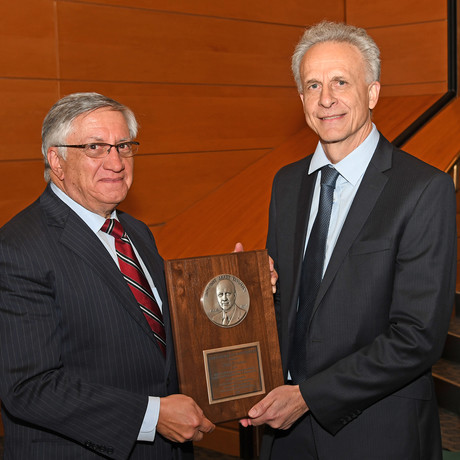
University of Newcastle Laureate Professor Kevin Galvin has received the prestigious Antoine M. Gaudin Award from the Society for Mining, Metallurgy, and Exploration (SME), which recognises scientific or engineering contributions that further understanding of the technology of mineral processing.
Professor Galvin is the director of the University of Newcastle’s Centre for Advanced Particle Processing and Transport and the ARC Industrial Transformation Research Hub for Advanced Technologies for Australian Iron Ore. He is the fifth Australian to receive the international award in 42 years, with the society recognising him “for advancements in the science and engineering of innovative systems for coal and mineral beneficiation”.
Based at the Newcastle Institute for Energy and Resources (NIER), Professor Galvin created the Reflux Classifier, a technology that has been credited with saving the global mining and minerals processing industry hundreds of millions of dollars. The award also recognises Professor Galvin’s other innovative systems, including the Reflux Flotation Cell, which is being commercialised.
An award winner in its own right, the Reflux Classifier is an industrial machine that separates fine particles from water using a system of inclined channels to recover valuable material, generating both environmental and cost benefits. The technology was developed in collaboration with commercial partner Ludowici, and more recently, FLSmidth.
As the Antoine M. Gaudin Award winner, Professor Galvin presented a plenary lecture at the SME’s annual meeting in Minneapolis last month. He follows in the footsteps of his University of Newcastle colleague, Laureate Professor Graeme Jameson, who received the award back in 2012.
Curiox Biosystems sues BD and Waters for NDA breach
Curiox Biosystems has filed a lawsuit against BD and Waters Corporation for trade secret...
Australia signs Horizon Europe agreement in landmark deal
The agreement provides Australian researchers and organisations with access to Horizon Europe...
Suspicious citation numbers found in high-impact journals
The likely manipulation of citation numbers by research paper mills in high-impact cancer...