Onsite detection of Devil's Breath in drinks
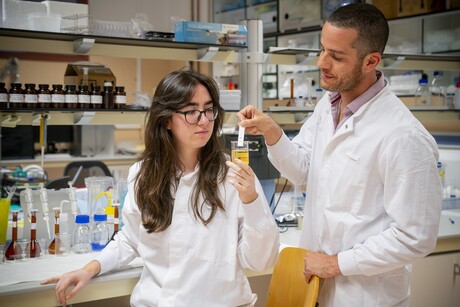
Researchers at the University of the Basque Country - EHU have developed a microfluidic paper-based device that provides a rapid, reliable and easy way to detect the drug scopolamine and related compounds.
Described in the journal Talanta, and forming part of the doctoral thesis being undertaken by Isabel Poves in the Microfluidics Cluster research group, the work provides a significant advancement towards the practical, onsite detection of drug-facilitated assault agents.
Assault facilitated by drugs such as scopolamine (popularly known as Devil’s Breath) is a serious public health and forensic concern. This drug is especially hazardous due to its strong amnesic, sedative and hallucinogenic effects, combined with a lack of colour, odour and taste that prevent it from being detected when ingested.
Despite its toxicological importance, there are few methods available for the rapid onsite detection of scopolamine, as the detection of these types of drugs relies on the use of instrumental analytical techniques. This means that, in order to find out whether something has been added to your drink, you have to take a sample to a specialised laboratory for analysis.
To address the lack of portable, low-cost analytical tools for detecting scopolamine without the need for a laboratory, the Microfluidics Cluster group has developed a self-powered, microfluidic paper-based device for the rapid detection of scopolamine in pharmaceuticals, plant extracts and beverages. Discreet, portable and easy to use, their system consists of a self-powered microfluidic device with a paper support on which a reaction occurs, which provides a colour change according to whether the result is positive or negative.
“The device is immersed in the sample for a few seconds, and after around 10 minutes the result can be seen with the naked eye, without the need for any other type of detector,” said Poves, who served as lead author on the study.
Microfluidic technology consists of miniaturising or simplifying processes that are carried out on a larger scale in a laboratory, so that the sample does not need to be handled in any way. This enables a preliminary analysis to be conducted onsite, which should help to prevent drug-facilitated assault — “because more important than detecting it after the fact is trying to prevent it from happening in the first place”, Poves noted.
The study helps bring scientists closer to the objective of developing a microfluidic platform capable of detecting multiple drugs through a single colorimetric reaction. In fact, it forms part of a larger project led by the Microfluidics Cluster group, which seeks to detect as many drugs as possible using a single device. This would involve integrating various known chemical reactions used for drug detection into microfluidic technology and improving the designs, thus taking advantage of the ability to achieve rapid results.
“We are trying to adapt the colorimetric chemical reactions to microfluidic technology in order to simplify this type of detection, to lower costs, automate the process and, in particular, to be able to see with the naked eye a colour change indicating that a beverage has been adulterated,” said Ikerbasque Research Professor Lourdes Basabe-Desmonts, lead researcher of the group. In this respect, the group has recently developed another device aimed at detecting benzodiazepines (eg, Diazepam, medically used for treating conditions such as anxiety and insomnia) in beverages, with the same characteristics as the device in this study.
The researchers acknowledged that they still need to improve their devices in order to optimise the detection ranges, colour changes, etc. In the future, such analysis could potentially be conducted using existing smartphone applications that accurately analyse the colour displayed on the device.
Continuous monitoring helps safeguard research integrity
Omniflex has helped clinical research organisation CAPRISA protect temperature-sensitive...
Quantum sensors enable more accurate nuclear monitoring
Researchers have found a way to more accurately measure X-ray emissions from three radioactive...
Scientists detect possible dark matter interaction
First proposed nearly a century ago, dark matter accounts for around 85% of the mass in the...