AI helps scientists identify bacteria hidden in soil
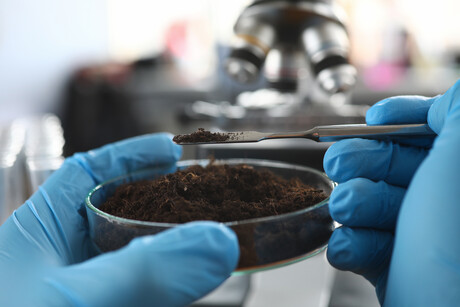
A handful of soil holds a crowded world of bacteria, fungi and other organisms — but while scientists can collect their DNA, much of it remains difficult to identify. Researchers at The Hebrew University of Jerusalem and their collaborators have now developed an artificial intelligence tool that helps make sense of this genetic puzzle, with their results published in the journal Nucleic Acids Research.
To study life in soil, scientists can extract and sequence DNA from an entire sample at once; this produces millions of short genetic fragments from many different organisms. The challenge is figuring out which fragments belong to bacteria and what information they contain, like sorting a huge pile of puzzle pieces from many different puzzles — often without knowing what the finished pictures should look like.
Existing tools commonly identify fragments by comparing them with DNA sequences stored in reference databases, but many soil organisms are missing from those databases. Without a suitable match, their DNA can remain unidentified or be labelled incorrectly. Researchers often call this unexplained genetic material ‘microbial dark matter’.
The researchers’ tool, dubbed ‘BBERT’, approaches the problem differently, using a type of AI that is also used in language technology. Instead of learning patterns in sentences, it learns patterns in bacterial DNA, allowing it to recognise bacterial fragments just 100 DNA ‘letters’ long. Once trained, it can assess an unfamiliar fragment without needing to find a matching sequence in a reference database.
The tool asks three questions:
- Does this DNA look bacterial?
- Does it contain instructions for making part of a protein?
- If so, where should the cell’s reading machinery start grouping the DNA letters to interpret those instructions correctly?
In benchmark tests, BBERT distinguished bacterial from non-bacterial DNA with approximately 90% accuracy, outperforming the other deep-learning tools evaluated. It also identified fragments containing protein-making instructions with approximately 88% accuracy and their correct reading frame with approximately 96% accuracy.
Having been applied to 1969 publicly available soil DNA datasets, BBERT identified a substantial share of fragments that a widely used comparison tool had left unclassified. The results added a clue to the mystery of microbial dark matter: fragments that could not be linked to known functions were more likely to contain non-bacterial DNA than fragments that could be interpreted. This suggests that the mystery involves genetic material from several sources, alongside unfamiliar bacteria.
BBERT also helped with another demanding task: joining short DNA fragments into longer stretches to reconstruct bacterial genomes. In tests using simulated mixtures of organisms, filtering the DNA with BBERT before reconstruction reduced average processing time from about 66 hours to 25 hours per dataset. The reconstructed sequences contained fewer mismatches and gaps, while retaining approximately 96% of the average bacterial-genome coverage achieved without filtering.
Finally, the team tested the approach on DNA collected from wild legume root nodules — structures where plants house bacteria. These samples contain a mixture of plant and microbial DNA. BBERT filtering halved reconstruction time and cut peak computer memory use from 188 to 82 GB. It also reduced contamination in several reconstructed bacterial genomes, although some bacterial information was lost.
BBERT can run on a personal computer with a suitable graphics card, and the researchers also demonstrated it on a laptop. This could make it easier for laboratories without large computing facilities to analyse environmental DNA.
The tool is not perfect, however, as it can miss some bacterial fragments and mistake other DNA for bacterial DNA. For example, it can confuse DNA from chloroplasts — the structures plants use for photosynthesis — with bacterial sequences, reflecting their ancient bacterial origins. It can also struggle to distinguish bacteria from archaea, another major group of microorganisms.
In spite on its limitations, BBERT gives scientists a practical way to explore the hidden life in soil by making tiny DNA fragments easier to interpret. It could also help them return to existing collections of environmental DNA and uncover information that earlier analyses could not resolve.
Protein build-up in brain blood vessels and dementia risk
In the US, health information of over 1.9 million adults aged 65 and older has led to suggested...
Proteomic approach identifies new blood-clotting disorder
Analysis of lethal antibodies has helped Australian and international researchers identify a new...
Blood test for chronic fatigue syndrome developed
The test addresses the need for a quick and reliable diagnostic for a complex,...