Could this 'virus-tearing' plastic film protect hospital equipment?
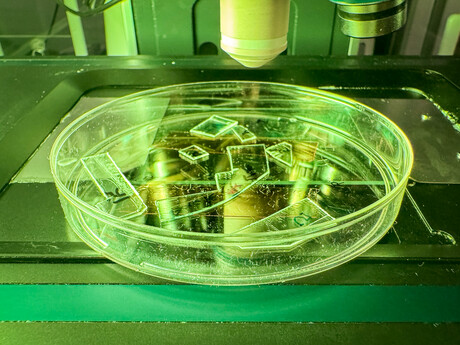
A thin plastic film that tears apart viruses on contact could help protect high-touch hospital equipment from spreading disease, Australian scientists believe.
A flexible acrylic surface textured with ultra‑fine structures called nanopillars — that grab and stretch the outer shell of the virus so much that it ruptures, killing the virus through mechanical force rather than chemical disinfectants — is an innovation that, Australian scientists believe, is not only effective at killing viruses, but also far more practical and scalable than earlier metal and silicon‑based antiviral surfaces.
Human parainfluenza virus 3 (hPIV-3), which causes bronchiolitis and pneumonia, was used in lab tests, which revealed that, within one hour of contact with the surface, about 94% of the virus particles were either ripped apart or damaged to the point where they could no longer replicate to cause infection. The research, published open access in Advanced Science (doi: 10.1002/advs.202521667), shows that, unlike earlier studies on antiviral coatings, stretching rather than skewering viruses is a more effective kill.
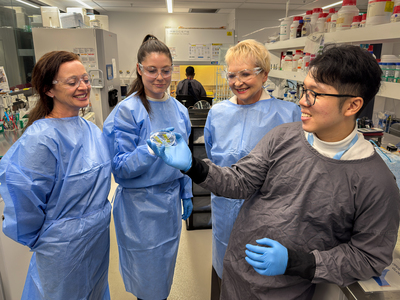
“As nanofabrication tools get better, our results give a clearer guide to which nanopatterns work best to kill viruses,” said Samson Mah, study lead author and RMIT University PhD candidate. “We could one day have surfaces like phone screens, keyboards and hospital tables covered with this film, killing viruses on contact without using harsh chemicals.
“Our mould can be adapted to roll‑to‑roll manufacturing, meaning antiviral plastic films could be produced at scale with existing factory equipment.” Mah said the research revealed how distance between the nanopillars matters far more than their height. “By tweaking the spacing and height of the nanopillars, we discovered how tightly they are packed together is far more important than how tall they are for breaking viruses apart.
“When the nanopillars are closer together, more of them can press on the same virus at once, stretching its outer shell past breaking point,” Mah added. While rigid substrates — such as nanospike silicon — in early experiments showed viruses could be physically disrupted, surfaces textured with not only spike-like nanofeatures, but also with blunt nanopillars were shown in the study to efficiently kill viruses.
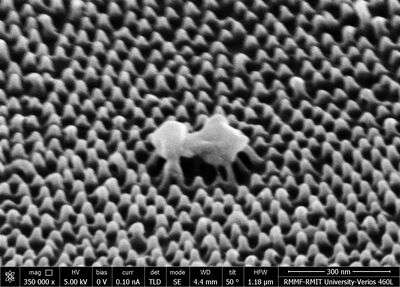
The same virus‑killing action is shown in this study on flexible plastic, proposing a simple design rule: the closer together the nanofeatures such as spikes or nanopillars are, the better they work; the strongest effect coming from densely packed nanopillars with about 60 nanometres between them, while widening the gaps to 100 nanometres reduced the antiviral power and 200 nanometres effectively switched it off.
An enveloped virus has a fragile fatty membrane around it that can be more easily disrupted by nanopillars, while a non-enveloped virus lacks this outer layer, making it harder to kill. Having focused on hPIV‑3 — an enveloped virus with a fatty outer membrane — to see how broadly the nanotextured surface works, the team said it now plans to test smaller and non‑enveloped viruses. Also needed is more research on the texturing’s effectiveness on curved surfaces, which affects the nanopillars’ spacing.
Award-winning system automates vial filling for cell therapy
Celleo's Larkem V40 — created to address one of the bottlenecks holding back cell...
Air pollutant exposure linked to glaucoma, cataracts and suicide
People who are exposed to high levels of air pollution are more likely to develop glaucoma and...
Could this 'nanobone' material allow children to regrow bone?
Australian scientists believe they have found an alternative to invasive bone graft procedures in...