Could this optical centrifuge demystify exotic, frictionless superfluids?
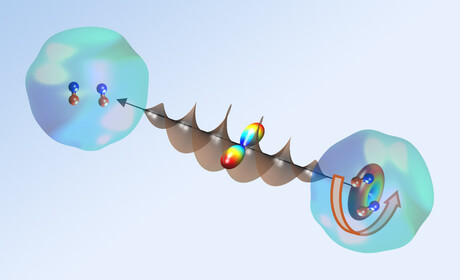
A new optical centrifuge has enabled the first demonstration of controlled spinning inside a superfluid, recent research suggests. It means researchers can now directly set the direction and frequency of the molecule’s rotation, which is vital in studying how molecules interact with the quantum environment at various rotational frequencies — as outlined by researchers at the University of British Columbia (UBC) and colleagues at the University of Freiburg in the journal Physical Review Letters (doi.org/10.1103/5jnj-97vs).
“Controlling the rotation of a molecule dissolved in any fluid is a challenge,” said Dr Valery Milner, author on the paper and Associate Professor with UBC Physics and Astronomy. “Dissolved molecules interact with the atomic or molecular constituents of the fluid, effectively getting bigger and harder to spin up. Imagine making a snowball: it’s very easy to move it when it’s small, but gets harder and harder as more snow gets attached to it.”
Superfluids — like liquid helium — are exotic states of matter that, at near-absolute zero, flow with no viscosity. Yet they actually do act as solvents, despite the lack of friction. “The question of interest in the science of quantum matter, and the one this new approach will help us explore, is what changes from the perspective of the solvated — dissolved — molecule when you make the transition from a normal fluid to this type of quantum superfluid,” Milner said.
Already used to spin and study molecules in gases by shining a rotating laser pulse onto it, with conventional optical centrifuges, molecules in the gas align with the beam’s electric field and rotate with the pulse. But the technique hasn’t worked yet with molecules suspended in a superfluid.
For this study, the molecules were embedded in helium nano-droplets doped with dimers of nitric oxide by Milner and his team and introduced a short time delay between laser pulses. This caused interference that creates a much lower, constant rotation rate that increased the molecule’s ‘spinnability’.
The team will move on to scan the rotation frequency (using the new ‘control knob’ offered by the novel centrifuge) across a critical frequency, beyond which molecular rotation is expected to decay much faster due to the breakdown of superfluidity.
“It is not well understood how and when — for example at what frequency — this transition will happen at such a tiny atomic scale,” Milner said. “That’s the key area we’re investigating at the moment.”
Prototype promises to build light analysis directly into imaging hardware
Thanks to a new chip, researchers believe they may be able to help cameras capture details that...
Ultrasound improves protein recovery from cauliflower waste
Abundant but often discarded during processing, cauliflower leaves contain protein and dietary...
Can yawning advance the study of neurodegenerative diseases?
Australian neuroscientists using MRI scans to monitor flow of cerebrospinal fluid during yawning...