Poor antibody validation wastes millions of biological samples
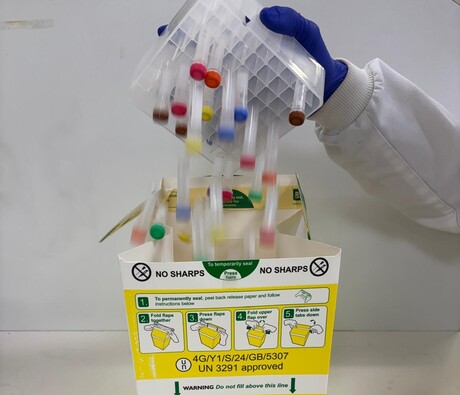
A widespread failure to validate research antibodies before use is believed to have led to the avoidable waste of millions of animal and human tissue samples worldwide, according to research published in PLOS Biology by Harvinder Virk of the University of Leicester.
Antibodies are critical reagents that enable researchers to detect, quantify and isolate specific proteins in biological samples. However, research antibodies do not always bind their intended targets, or may bind additional unintended targets; this was the case for Kirk when he discovered some years ago that data he had submitted in a grant application relied on an antibody that did not detect its intended target. Studies have since suggested that many antibodies do not bind as advertised — and this lack of specificity can misdirect biomedical research across fields.
In a recent paper, Virk and colleagues combined data from focus groups (12 researchers), a survey (107 researchers), and an analysis of 785 publications linked to antibodies that had failed rigorous, knockout-controlled testing. Among 760 publications where validation status could be determined, only 120 (15.8%) presented any validation evidence, despite 72% of surveyed researchers reporting having used at least one recommended validation method. The papers lacking antibody validation used a minimum of 8064 animal samples and 4424 human tissue samples. Extrapolating, the researchers estimate that millions of animal and human tissue samples have been consumed globally without adequate validation.
“This study provides, to our knowledge, the first systematic quantification of biological sample waste attributable to the use of poorly performing antibodies without context-specific validation,” the researchers said.
In a second paper, Virk and colleagues convened 32 international experts for a two-round Delphi consensus exercise to rate proposed reforms for antibody validation. The panel agreed that 15 actions — including institutional training, dedicated validation budgets in grant applications, and publisher reporting requirements — were both effective and feasible for implementation by 2030; a further 15 actions were judged effective but of uncertain feasibility. Participants pointed to diffuse ownership of the problem and market incentives that fail to reward antibody quality as key barriers.
“The findings lend themselves to a program of targeted stakeholder consultation,” the authors said. “To support this, we have prepared separate documents for each stakeholder group — publishers, funders, institutions and manufacturers — presenting consensus recommendations alongside implementation options derived from the panel’s qualitative feedback. These present options rather than prescriptions, recognising that the optimal approach will vary across organisations, countries and contexts.”
Katherine Blades, first author on the second study, said, “What struck us was the level of agreement once researchers, funders, publishers, institutions and manufacturers were brought into the same process. The panel reached consensus on 15 actions that are both effective and achievable by 2030. Progress is held back not by disagreement about what to do, but because no single group owns the problem — so everyone waits for someone else to move first.”
Virk concluded, “Together these papers show the problem has significant impact with ethical dimensions, and is solvable. Since completing this work, we have embedded champions for better practice in 14 UK research institutions, and the University of Leicester has made antibody validation training mandatory for its bioscience postgraduate researchers. We are working with two national funders — the NC3Rs and Cancer Research UK — on implementation solutions, and have built free tools publishers can use to protect the integrity of what they publish.”
Antibody treatment reprograms immune system after heart attack
A new drug being trialled in heart attack patients could reprogram the immune system to prevent...
Nanoparticles supercharge vinegar's wound-healing power
Adding microscopic particles to vinegar can make them more effective against dangerous bacterial...
Not all brown snake venoms are alike, causing antivenom concerns
Venom from northern and southern populations of eastern brown snake builds blood clots in very...