Self-disinfecting fabric developed for hospitals
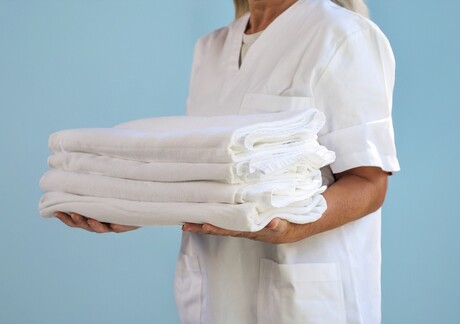
Researchers from Spain’s Universitat Politècnica de València (UPV) have developed a self-disinfecting cotton fabric capable of eliminating bacteria, fungi and viruses in hospital settings using visible light. The material incorporates two photoactive compounds which, when exposed to light, generate a highly reactive form of oxygen that damages the microorganisms adhering to the fabric, thereby eliminating them. It has been described in the journal ACS Applied Materials & Interfaces.
As explained by study co-author Marilés Bonet, the researchers set out to develop fabrics capable of reducing the presence of microorganisms in healthcare settings, thereby mitigating some of the problems associated with conventional antimicrobials — such as a loss of efficacy with use or when washed, or the promotion of resistant microorganisms. “That is precisely what we have achieved in this study,” she said.
In laboratory tests, the fabric completely inactivated Escherichia coli within 60 minutes and Enterococcus faecalis within 20 minutes when exposed to light. It also achieved a reduction in Candida albicans within three hours.
“The material also retains a significant proportion of its activity after repeated washes,” said Pilar Moya, from the UPV’s Mediterranean Agroforestry Research Institute. “Even after 20 cycles, it maintained a bactericidal efficacy above the reference levels used for antimicrobial fabrics.”
Hospital validation was carried out in the rooms of 12 patients at La Fe University and Polytechnic Hospital in Valencia. The fabrics were placed in two areas of the rooms for 48 hours: the bed rails, exposed to light, and the mattresses, which received less light. In addition, the research team used untreated cotton fabrics as a control.
“In the hospital rooms, the fabric exposed to light accumulated 75% fewer microorganisms than a conventional cotton fabric placed under the same conditions,” said Inmaculada Andreu, from the Joint Research Unit between UPV and the Health Research Institute Hospital La Fe.
“When the material was placed in an area without direct light, the reduction was much lower — just 25% — confirming that its antimicrobial effect depends largely on lighting. The efficacy was particularly high against Gram-positive bacteria, with their presence reduced by 77.5%.”
According to the researchers, the process used to manufacture this fabric could be easily integrated into standard textile-finishing techniques. This would facilitate the large-scale development of new self-disinfecting textiles for hospitals.
Poor antibody validation wastes millions of biological samples
A widespread failure to validate research antibodies before use is believed to have led to the...
Antibody treatment reprograms immune system after heart attack
A new drug being trialled in heart attack patients could reprogram the immune system to prevent...
Nanoparticles supercharge vinegar's wound-healing power
Adding microscopic particles to vinegar can make them more effective against dangerous bacterial...