Sovereign capability: designing the infrastructure of translation

Australia is entering a pivotal period in the evolution of its science, technology and manufacturing sectors. Federal investment across medical research, innovation, advanced manufacturing and sovereign capability signals a broader national shift, one focused not only on discovery but on strengthening the systems that enable research to translate into impact at scale.
Across biomedical science, synthetic biology, advanced therapeutics, defence technologies and emerging industries, Australia is generating globally recognised innovation. Realising its full value now depends on how effectively that capability is connected across industry, manufacturing, health care and national resilience.
This is where infrastructure, and increasingly architecture, plays a critical role by enabling movement between research, manufacturing, computation and application within increasingly interconnected capability ecosystems. For architects, this marks a shift away from designing isolated buildings towards conceiving connected systems that support adaptation, collaboration and scale. In this context, architecture becomes part of the infrastructure of translation.
Capability shift: from buildings to ecosystems
For decades, research laboratories and scientific facilities were conceived as standalone assets — highly specialised buildings organised around fixed operational models and singular functions. Increasingly, this model no longer reflects the complexity of today’s research and industry landscape.
Biomedical, artificial intelligence and advanced technology sectors are no longer operating in isolation. They now sit across connected domains of research, digital infrastructure, manufacturing, logistics, clinical translation, cybersecurity and workforce development, where knowledge moves continuously between disciplines and applications rather than through a linear pipeline.
For architecture, this changes the brief. Laboratories, manufacturing environments and innovation precincts can no longer be treated as standalone assets. They need to be conceived as part of broader sovereign capability networks, designed to support agility, scale, resilience and rapid translation.
Projects such as the Viral Vector Manufacturing Facility (VVMF) at Westmead Health & Innovation District and Australia’s first RNA Research and Manufacturing Facility within the Macquarie University Innovation Precinct are indicative of this evolution. Both extend beyond the conventional clinical laboratory typology by integrating research, pilot-scale manufacturing, digital systems and translational workflows within a single operational framework to create environments designed not only for discovery, but for acceleration and application.


Adaptive labs: designing for wellbeing and scale
Laboratory environments are being fundamentally reconfigured by automation, robotics, AI-driven analytics and high-throughput sequencing. The result is a new generation of hybrid settings where people, machines and data operate in constant exchange.
At the VVMF, designed by HDR for Health Infrastructure, the facility supports the production of clinical-grade viral vectors for gene and cell therapies, vaccines and advanced therapeutics. As a translational platform, it bridges scientific discovery and clinical application. The design balances technical precision with human experience, introducing daylight, clarity and improved spatial quality into highly controlled environments. This recognises that workforce attraction, retention and performance are now central to the success of advanced science infrastructure.
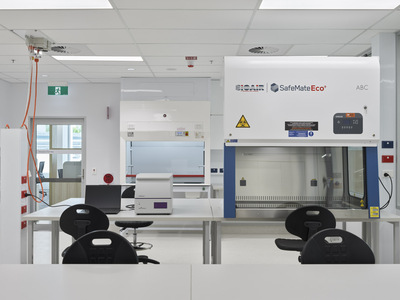
Australia’s first RNA Research and Manufacturing Facility extends this thinking through a framework designed for continuous evolution. The facility incorporates synthetic RNA and mRNA production suites, lipid nanoparticle encapsulation, pilot-scale fill-and-finish capability and QA/QC laboratories within a highly adaptable spatial system. Set within a biophilic landscape of mature eucalyptus trees, it combines precision science with environmental and cultural context, reinforcing the role of workplace quality in sustaining high-performing teams.
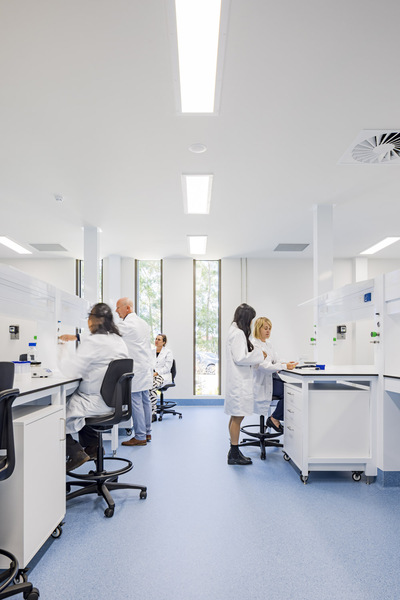
In parallel, CSIRO’s Australian Centre for Disease Preparedness demonstrates the sovereign dimension of scientific infrastructure. Positioned at the intersection of biosecurity, diagnostics and national response readiness, it shows how advanced facilities must also operate as protective systems, supporting preparedness for biosecurity events, zoonotic outbreaks and emerging health threats.
Across these examples, research, production, preparedness and human-centred design are no longer separate typologies. They form part of a single operational continuum. As translational science advances, architecture must do more than accommodate technical complexity. It must create environments that support adaptability, legibility, workforce performance and resilience under conditions of continuous change.
Digital science: data as critical infrastructure
Artificial intelligence is changing how scientific research is planned, tested and translated. In biomedical fields, modelling, simulation, bioinformatics, imaging and sequencing are increasingly shaping experimental pathways before physical testing occurs.
As these workflows become embedded in research and manufacturing environments, data can no longer be treated as a back-of-house technical layer. Secure connectivity, high-performance computing, cybersecurity, resilient networks and large-scale data environments are becoming core infrastructure, comparable in importance to power, water and specialist services.
This has direct implications for precinct planning. Research, manufacturing and digital systems need to be conceived as interdependent operational layers, not discrete facilities. The quality of future capability will depend not only on scientific expertise, but on the speed, security and confidence with which data can move between people, platforms and applications.
Innovation ecosystems: cities as connected systems
Innovation is increasingly being organised at the scale of precincts and cities. In Sydney’s Tech Central at Camperdown, for example, biomedical and advanced manufacturing capability is increasingly defined not by individual institutions but by the strength of connected networks spanning universities, hospitals, research organisations, government agencies and industry partners operating within shared environments.
The Sydney Biomedical Accelerator exemplifies this model. Located at The University of Sydney and Royal Prince Alfred Hospital, the 36,000 m2 facility integrates biomedical science with clinical research and innovation within a single translational environment. Delivered through a partnership between the NSW Government, Sydney Local Health District and The University of Sydney, it brings together education, research laboratories, specialist core facilities and technical infrastructure within a unified framework designed to support multidisciplinary collaboration. Its flexible spatial structure enables continuous exchange between researchers, clinicians and students, strengthening pathways from discovery to clinical application and reinforcing architecture’s role in enabling integration across complex innovation ecosystems.

Effective precincts, therefore, are not defined by proximity alone, but by how deliberately they are structured to support interaction, flexibility and sustained connection.
Capability era: designing Australia’s future
Over the coming decade, Australia’s science and manufacturing environments will continue to converge, forming integrated systems where research, advanced manufacturing, AI infrastructure and digital technologies operate within continuously evolving precincts.
This convergence introduces both opportunity and complexity. Fields such as advanced manufacturing, synthetic biology, quantum technologies and digital systems now sit at the intersection of sovereign capability, health care and critical infrastructure. The challenge is no longer discovery alone, but translation at scale.
Australia’s next generation of science infrastructure will not be judged by technical sophistication alone. Its value will be measured by how effectively it connects discovery, production, data, clinical application, workforce capability and national resilience. In this context, architecture has a larger role to play, not simply shaping buildings but helping structure the systems through which sovereign capability can translate into impact.
Brain Institute and Clinic unites research with patient care
The fight against some of the world's most devastating brain diseases has entered a new phase...
Testing laboratory completes major upgrade
ALS's new base in Smithfield, in Greater Western Sydney, remakes a 20-year-old facility that...
Scientific rigour within a person-centred, biophilic setting
The $96 million, 4500-square-metre RNA Research and Manufacturing Facility has opened within the...