Could this 'nanobone' material allow children to regrow bone?
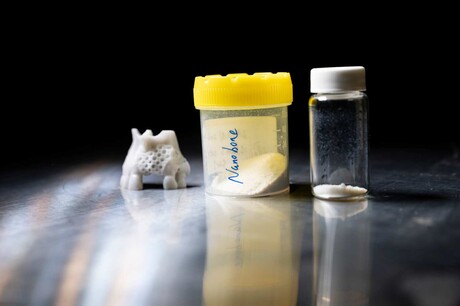
Australian scientists believe they have found an alternative to invasive bone graft procedures in children — procedures that have changed little in over 50 years.
Children born with cleft lip and palate often need to wait until they are 10 to 12 years old, to then undergo invasive bone graft surgery to repair gaps in the jawbone. Now, University of Sydney researchers have developed a biodegradable ‘nanobone’ material that, they say, allows the body to harness its own healing properties to regrow bone and, it is hoped, could allow treatment much earlier in childhood — reducing the need to wait years for bone grafting.
Researchers at the University of Sydney School of Dentistry, Charles Perkins Centre and Sydney Nano developed the material in collaboration with the University of Queensland, with the study finding that, in a preclinical bone model, the material generated approximately 80% more new bone than a material control after eight weeks. A key bone-repair growth factor was also found to be activated — with around 10 times the level achieved using conventional methods.
“The material activates dormant repair signals in the body, triggering a cascade of healing processes that attract bone-forming stem cells and stimulate new bone growth,” said lead researcher Associate Professor Chun Xu, a Sydney Horizon Fellow in the Faculty of Medicine and Health. “One of the biggest challenges for children born with cleft lip and palate is repairing the bone defect in the jaw,” Xu added.
“Our long-term goal is to develop materials that help the body regenerate bone naturally and reduce the need for these invasive and painful procedures. We hope this could allow treatment much earlier than is possible today.” The material is a calcium–aluminosilicate nanomaterial that activates a naturally occurring growth factor called latent Transforming Growth Factor β1 (TGF-β1), which already exists within the body.
The material, once activated, attracts bone-forming stem cells to the injury site and encourages them to develop into bone-producing cells. The process then, over time, replaces the material with the body’s own tissue. Also helping stabilise the injury site during the earliest stages of healing, the material has been found to promote blood clotting within around 30 seconds.
“Our body already contains many of the signals needed for tissue repair,” Xu said. “We’ve developed a material that can help activate those signals at the right place and time. Instead of supplying external growth factors, we’re encouraging the body to use its own healing potential.”
Remaining in the preclinical stage with further testing required before human trials can begin, the researchers believe the technology could have applications beyond cleft lip and palate, including traumatic injuries, tooth loss and other difficult-to-repair bone defects. “Every patient is different and every bone defect is different,” Xu said. “In the future, we hope to combine these materials with advanced 3D-printing technologies so treatments can be tailored to the specific needs of each patient.”
The study was published in ACS Nano: doi.org/10.1021/acsnano.6c05126.
Award-winning system automates vial filling for cell therapy
Celleo's Larkem V40 — created to address one of the bottlenecks holding back cell...
Air pollutant exposure linked to glaucoma, cataracts and suicide
People who are exposed to high levels of air pollution are more likely to develop glaucoma and...
The last mile of life sciences innovation
How do we translate technological possibility into meaningful real-world impact?