Breast augmentation procedure uses 3D-printed scaffolds
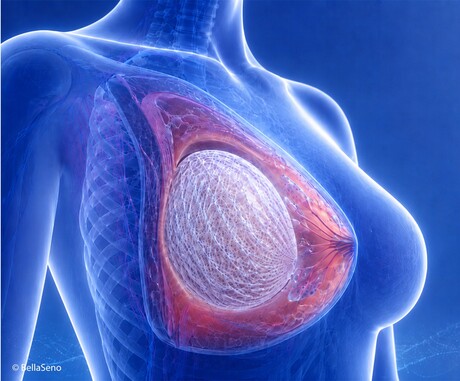
In what is understood to be a world first, 3D-printed scaffold technology from medtech company BellaSeno has been used in a primary breast augmentation procedure at Macquarie University as part of a pivotal trial.
The procedure was performed on 10 August by Professor Anand Deva, Head of Plastic and Reconstructive Surgery at Macquarie University and the Director of the Integrated Specialist Healthcare Education & Research Foundation (ISHCERF). Deva is principal investigator of the trial, which is being conducted by Macquarie University and ISHCERF using BellaSeno’s scaffold technology.
The scaffold is manufactured from 100% medical-grade polycaprolactone, a material with a long history of use in absorbable medical devices. Used in conjunction with the patient’s own fat, the scaffold’s open 3D architecture provides initial form and maintains space while the grafted fat integrates with surrounding tissue. The scaffold is designed to gradually resorb over time.
The trial will evaluate the safety and performance of the scaffold, including its ability to provide temporary structural support and maintain space for tissue ingrowth over time. The procedure on 10 August marks the first participant treated in the 53-person primary augmentation component of the trial, which — according to Deva — reflects a growing need to provide women with options for breast augmentation that work naturally with the body.
“For decades, breast augmentation has relied on the same approach — a permanent implant to add volume,” Deva said.
“Silicone implants have served women well and will remain an important option for many, and we are optimistic about the additional choices this new technology can offer.”
Dr Mohit P Chhaya, co-founder and CEO of BellaSeno, said the technology originated with his PhD research in Queensland in 2011 and has since been advanced by engineers, scientists, surgeons and patients across Australia and Europe.
“For BellaSeno, this is the point at which 15 years of research, engineering and clinical collaboration enters an important new chapter,” Chhaya said.
“Our Breast Scaffold was developed to provide temporary structure and work in conjunction with a patient’s own tissue. Through this trial, we are now evaluating whether that approach may broaden the future choices available to women who want breast volume restoration or augmentation but may not want a permanent implant.”
The primary augmentation procedure builds on BellaSeno’s first-in-human safety investigation, led by Professor Owen Ung at Metro North Health’s Comprehensive Breast Cancer Institute and the Herston Biofabrication Institute between 2021 and 2023. That study, which involved 19 consecutive patients, reported no scaffold-related complications, high patient satisfaction and 83% mean breast volume retention.
“The initial clinical investigation gave us important early evidence about the scaffold’s safety profile and patient outcomes, paving the way for this next phase and the possibility of helping more patients,” Ung said.
“The next stage of this work is about continuing to build that evidence responsibly, with rigorous clinical oversight, longer-term follow-up and a clear focus on patient safety.”
For more information about the pivotal trial, including participation details, visit bellaseno.com/breast-scaffold.
Unhealthy Western diet could accelerate cognitive decline
An unhealthy Western-style diet is associated with a faster cognitive decline in people with a...
Cancer drug enters clinical trials based on a false mechanism
A cancer drug currently being tested in patients appears to have entered clinical trials based on...
Russia insists there is "no plague case" following lab worker death
Russian health authorities say there is no evidence that pneumonic plague played a part in the...