Voice-activated system for hands-free pathogen handling
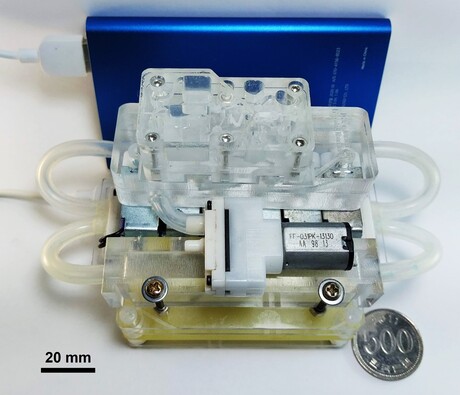
Smart voice assistants are a popular way for people to get quick answers or play their favourite music. Now, South Korean researchers are deploying that same technology to make the laboratory safer for scientists and technicians who handle potentially infectious samples, as well as those with disabilities.
Scientists working with samples containing pathogens need to work with the smallest amounts possible to avoid accidental infection — and for highly contagious bacterial diseases, onsite sample analysis is ideal for rapid diagnosis. In addition, scientists who have visual or other physical impairments may find it difficult to operate complex instruments, especially those designed for tiny volumes. Hands-free devices that operate quickly through voice commands could make this process easier and safer — so Tae Seok Seo and colleagues at Kyung Hee University set out to combine a speech recognition app with a miniaturised extraction system to do just that.
The researchers first made a microfluidic chip with multiple chambers linked together by several three-way solenoid valves, which were operated by a microcontroller connected to a Bluetooth module. The palm-sized device weighed just over 300 grams and could be powered by a portable battery or a 5 V smartphone charger. Then, using existing speech recognition software, the team customised a smartphone app to listen for specific voice commands.
Once a user says one of the operation commands out loud, the app wirelessly sends an initiation signal to the microcontroller. After receiving the signal, the microcontroller automatically starts a series of steps, including sample loading, washing and releasing the purified DNA into a collection chamber. The system currently requires the user to touch the smartphone to start the speech recognition software, but the researchers say that the whole operation could be made entirely hands-free in the future with the addition of virtual assistant software.
In tests, the voice-controlled device extracted DNA from Salmonella Typhimurium, purifying a 10 µL sample with an efficiency of 70% in less than a minute. While this is a lower performance than a traditional DNA extraction kit, the researchers say the system’s voice control, portability and quick automation make it useful for convenient and safe bacterial DNA testing. Their work has been described in the journal ACS Sensors.
Biodegradable smart patch can detect and treat blood clots
Researchers have developed a biodegradable smart patch that detects pressure changes and releases...
Maternal diet doesn't affect baby's food allergy risk
Higher maternal consumption of egg and peanut during pregnancy and breastfeeding does not protect...
Overuse of inhalers can increase heart attack risk
Overuse of reliever inhalers is associated with higher risks of developing and dying from...