WEHI's Vaux wins Victoria Prize
Tuesday, 05 August, 2003
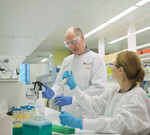
Walter and Eliza Hall Institute cancer researcher Dr David Vaux has been awarded the 2003 Victoria Prize for his pioneering work on the how, when and why of cell death.
Vaux has spent the last 15 years researching the mechanisms of programmed cell death, or apoptosis. While the concept of programmed cell death has been around for decades, Vaux discovered a specific gene, Bcl-2, which inhibited cell death in follicular lymphoma cells. "Bcl-2 became the first molecular component of cell death," he said.
Vaux's seminal 1988 Science paper on the role of Bcl-2 in apoptosis transformed the focus of cancer research, which previously had targeted excessive cell production as a cause, and was hailed as a cancer gene milestone by the journal. Apoptosis has since become a major focus of biological research, with applications not just to cancer but also to other diseases including heart attacks, stroke and autoimmune diseases.
Vaux has continued to look at the molecular mechanisms of apoptosis and its role in cancer and other diseases. His demonstration that the human Bcl-2 gene inhibited cell death in the nematode worm C. elegans showed that cell death processes in the genetic model were relevant to human disease.
His current focus is using drugs to inhibit cell death to reduce damage to the heart muscle following heart attacks, or to the brain after a stroke.
"It's a case of knowing how your enemy works," Vaux said.
Vaux's $50,000 Victoria Prize will be accompanied by the $100,000 Anne and Eric Smorgon Award, which is made to the sponsoring research institution -- in this case, WEHI.
Fellowships
In addition to the Victoria Prize, six young researchers have been awarded $15,000 Victoria Fellowships to undertake short-term international studies abroad.
Among them is Tanya Medley, a student at the Baker Heart Research Institute, who will use her fellowship to work with Prof Austin Smith at the Institute for Stem Cell Research in Edinburgh for up to three months to explore adult stem cell-based therapies for cardiovascular disease.
Announcing the awards, Victorian Minister for Innovation John Brumby said the Victoria Prize highlighted leadership, determination and creativity in science, engineering and technology innovation.
"By highlighting the achievements of our best and brightest, we hope to encourage the broader community to embrace research, innovative development and the commercial realisation of new ventures in science, engineering and technology," he said.
The Governor of Victoria, John Landy, will present the awards at a gala ceremony tonight.
Heart muscle regeneration genes mapped
Researchers have uncovered insights into how stem cells develop and mature into heart muscle...
The cause of 2022's mpox outbreak revealed
Researchers have discovered that the strain of mpox behind the 2022 outbreak was a weakened form...
New gene therapy treats liver disorder in growing children
Researchers have developed a genome-editing approach that repairs a faulty gene directly at its...