Neuroproteomics facility offers researchers a new perspective on MND and neurodegeneration
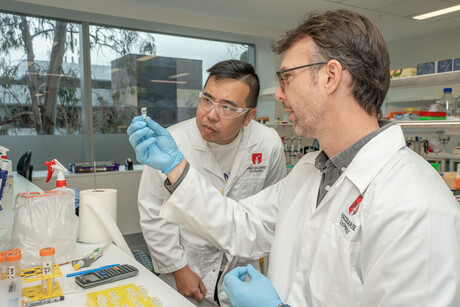
The National NeuroProteomics Facility recently commenced operations at Macquarie University. Stephen Downes speaks with the facility’s academic director.
The science of proteomics isn’t necessarily easy to explain to the uninitiated.
But Associate Professor Albert Lee, Academic Director of the new National NeuroProteomics Facility (NNPF) at Macquarie University, draws on an evocative metaphor.
“I liken it to being at the top of Sydney Tower looking down on the Sydney CBD,” he said.
“Much of the important research in neuroscience focuses on individual receptors or pathways or molecules — I guess that’s like looking up close at the Pitt Street Mall or the Opera House or Town Hall Station.
“But with proteomics, we can add a ‘big picture’ perspective on what’s going wrong — where traffic is banking up, where people are congregating, or where the power has gone out, and what the knock-on effects are likely to be for all the other systems.”
The NNPF, established with an AU$2 million five-year National Research Infrastructure grant from awareness and advocacy organisation FightMND, has just commenced operations at Macquarie.
Lee, who has led proteomics within the MND Research Centre at Macquarie University since 2014, said the inception of NNPF aims to revolutionise research into MND and other neurodegenerative diseases by using powerful tools to measure and analyse thousands of proteins in nerve cells.
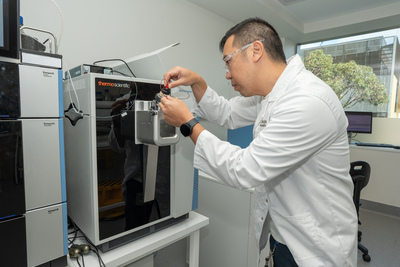
“FightMND’s support has been transformative — it’s allowed us to build the infrastructure needed to take MND proteomics to a national scale, giving researchers across Australia access to capabilities that simply didn’t exist before,” he said.
Abnormally formed and misfolded proteins clumping together inside neurones — disrupting function and eventually leading to cell death — are a characteristic finding in MND. Applying proteomics techniques and tools will help give researchers unprecedented insight into the roles played by numerous different proteins in MND disease processes.
“Neuroproteomics gives us the ability to look across the complete set of proteins in brain tissue and provides the functional context for what’s going on in the cells,” Lee said.
“To return to the Sydney Tower analogy, if we can see from up there that, say, Bathurst Street is blocked up, then that’s what we’d then advise researchers with a more specific focus: ‘There’s something wrong in Bathurst Street — maybe you should investigate that further and do some more detailed experiments.’”
Support from analytical equipment company Thermo Fisher Scientific will strengthen NNPF by providing researchers with greater access to advanced mass spectrometry technologies, technical expertise and workflow development support, Lee said.
“We already use high-performance Thermo Fisher Scientific technology platforms extensively, and this partnership helps accelerate our ability to produce robust, reproducible data at scale and translate discoveries into meaningful outcomes for patients.”
He said NNPF will help researchers not only identify therapeutic targets and accelerate the development of clinical trials but also find biomarkers for MND severity and progression.
“In addition to there being no specific treatment for MND, a key issue is that there’s nothing that can help us predict how long you’ll live with the disease once you’re diagnosed.”
While the search for a single biomarker specific to MND has so far not proved fruitful, he said, it’s increasingly likely that a panel of biomarkers will be needed to distinguish between different MND subtypes and variations.
“There’s a long way to go, but neuroproteomics is a means of getting us closer to the answers.”
More information on NNPF is available at www.mq.edu.au/research/research-centres-institutes-and-initiatives/motor-neuron-disease/our-research/our-research-platforms/national-neuroproteomics-facility.
Could this human tissue biobank find the cause of a bowel cancer surge?
In a new Australian biobank, lab comparisons of tissue donated by cancer patients will explore...
Microscopic life is mining decades-old toxic waste
At abandoned Flinders Ranges mines, stable radioactive and toxic metals are being turned into...
Dual-bubble approach achieves microplastic removal rates of over 90%
Using a combination of microbubbles and nanobubbles, Australian scientists have developed a...