Colour-changing material could help combat counterfeiting
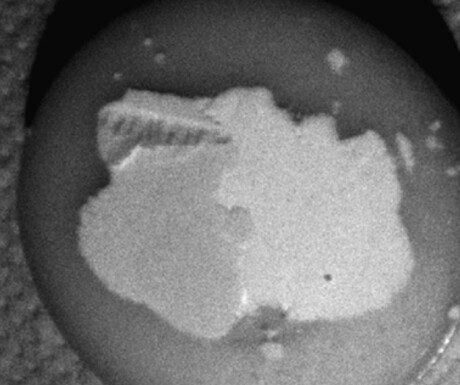
Researchers at the University of Turku have developed a material that changes colour in the near-infrared region, which they have described in the journal Angewandte Chemie. The colour change cannot be detected with the human eye, which could make the material suitable for use as an invisible anti-counterfeit tag.
The researchers began by studying the properties of hackmanite — a natural mineral that can also be produced synthetically. Hackmanite is photochromic, meaning that it can change its colour from white to pink or violet upon UV exposure. The colour reverts back to the original once the hackmanite is exposed to white light for a suitable period or when it is heated to 100°C.
“The development of this new material began with a thesis project carried out by a student in our research group,” said principal investigator Professor Mika Lastusaari. “The project demonstrated that the colour-changing properties of hackmanite are altered when calcium is introduced to the material instead of sodium. Rather than turning pink or violet, the material turned yellow. We also noticed that some of the material samples did not change colour visibly, but similar colour changes occurred in the near-infrared region, which is invisible to the human eye.”
The material that turned yellow was calcium hackmanite, but the active material in the near-infrared region was davyne, which belongs to the cancrinite mineral family. Davyne was produced as a by-product of calcium hackmanite synthesis. Calcium hackmanite and davyne have the same chemical formula, but their atomic structures are different.
At first the researchers found it difficult to produce pure davyne, as the material’s chemical equilibrium seemed to shift more readily towards calcium hackmanite than towards davyne. The research group continued to optimise the material and develop the manufacturing process in collaboration with materials engineering researchers, utilising, among other things, machine learning methods developed in materials engineering. In the end, the researchers succeeded in producing the purest possible form of davyne.
“At this stage, however, it was still a mystery to us what causes the colour change,” Lastusaari said. “We assumed that the mechanism was similar to that of hackmanite, where the colour change is caused by the transfer of an electron from a specific ion to a chlorine vacancy in the structure, and the size of this vacancy determines the colour the material turns into. However, davyne’s structure is different and the material has long, empty tunnels instead of the cavities that are typical to hackmanite. At the end, we were able to show that the colour-changing mechanism of davyne is similar to hackmanite.”
The researchers said that davyne is the only known material with a colour change that cannot be detected with the human eye — only with a spectrometer or an infrared-sensitive camera. They believe the material could have various applications, such as anti-counterfeit tags the likes of which are used in banknotes, passports and other official documents.
“We tested the functionality of davyne using an inexpensive camera from which all the colour detection filters had been removed, so that the remaining silicon chip detected a wavelength range specifically suited to davyne,” Lastusaari said. The tests showed that davyne’s colour change is clearly detectable under infrared light when the camera’s sensitivity is adjusted to davyne.
“The advantage of davyne over other invisible anti-counterfeit marking materials is that its near-infrared activity can be switched on and off,” Lastusaari said. “In practice, this means that the marking can be activated so that it is visible for inspection, and then returned to an invisible state.”
Reinforced ice is stronger and harder to shatter
Researchers have found a way to reinforce ice with tiny plant-based crystals and a specially...
Fingertip sensor identifies physical patterns linked to anxiety
An international study has provided early evidence that mental distress may be accompanied by...
Microplastics found to alter the human gut microbiome
Microplastic-treated cultures showed a consistent and significant increase in acidity (lower pH...