Fingertip sensor identifies physical patterns linked to anxiety

An international team of researchers has shown that measurements taken from a person’s fingertip could help identify physical patterns associated with stress, anxiety and depression.
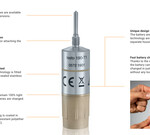
The team’s study, described in the journal Communications Medicine, used a wearable device that shines light into the skin to measure blood flow through the smallest blood vessels as well as changes in the activity of the surrounding tissue. These measurements were then combined with machine learning to investigate whether people reporting symptoms of stress, anxiety or depression displayed recognisable physical patterns, given that stress and anxiety can affect the nervous system, heart rate, circulation and metabolism.
The study involved 132 adults aged between 18 and 94 from across 19 countries. Participants completed a widely used 21-question assessment covering depression, anxiety and stress before undergoing repeated fingertip measurements.
The device meanwhile examined how blood was flowing through the tiny vessels beneath the skin. It also measured substances associated with how cells produce and use energy, as well as skin temperature and heart rate. Machine-learning models were then used to compare the physical measurements with participants’ questionnaire results.
The models were able to distinguish, with moderate success, between people who reported stress-related symptoms and those who did not. Blood-flow patterns and measurements associated with tissue metabolism made an important contribution to the results.
Professor Edik Rafailov, from the Aston Institute of Photonic Technologies in the UK, jointly supervised the research. He said the study provided early evidence that mental distress may be accompanied by measurable changes in the body; this could help other researchers investigate the relationship between mental health, circulation and cellular activity.
“This study suggests that non-invasive photonic wearable technology can detect changes in blood flow and tissue activity through the skin that may provide useful information about a person’s stress-related symptoms,” Rafailov said.
“At present, mental health is generally assessed through conversations and questionnaires. These remain extremely important, but in the future physiological measurements could provide an additional source of information and help people monitor changes over time.”
The researchers say the eventual aim would be to complement, rather than replace, existing mental health assessments, with the system potentially being used to help people and healthcare professionals monitor changes in wellbeing without requiring invasive medical tests. Larger studies and independent clinical validation will be needed to establish its reliability across different populations and everyday environments.
“This is an early proof-of-concept study, rather than a diagnostic test,” Rafailov said. “We now need to test the approach with larger groups of participants and in clinical settings before we can determine how it might be used in practice.”
Colour-changing material could help combat counterfeiting
Researchers have developed a material that changes colour in the near-infrared region, meaning...
Reinforced ice is stronger and harder to shatter
Researchers have found a way to reinforce ice with tiny plant-based crystals and a specially...
Microplastics found to alter the human gut microbiome
Microplastic-treated cultures showed a consistent and significant increase in acidity (lower pH...