Reinforced ice is stronger and harder to shatter
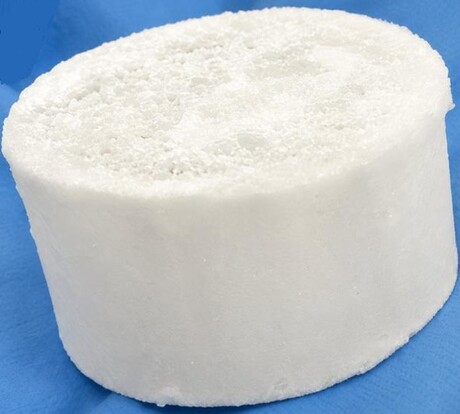
Ice is cheap, abundant and surprisingly strong, but it has one major weakness: cracks can race through it, causing it to shatter without warning. Now, a research team led by The Hebrew University of Jerusalem has found a way to reinforce ice with tiny plant-based crystals and a specially designed protein, resulting in a material that rivals concrete in strength. Dubbed ‘BioPykrete’, the material has been described in the journal Colloids and Surfaces B: Biointerfaces.
The idea of reinforcing ice is not new. During World War II, scientists experimented with Pykrete, a mixture of ice and wood pulp that was stronger and slower to melt than ordinary ice. The research team took that idea down to the molecular level.
They mixed ice with cellulose nanocrystals — extremely small, stiff particles made from cellulose, the natural material that gives plants their structure. As the mixture froze, the particles formed a three-dimensional network around microscopic sections of ice.
The scientists then designed a protein that could attach to both materials. One part of the protein binds to ice, while the other binds to cellulose. Acting like a molecular glue, the protein helps hold the entire structure together.
“We wanted to go beyond simply mixing fibres into ice and instead control how the different materials connect at the molecular level,” said research leader Professor Ido Braslavsky. “The result changes not only how strong the ice is, but also how it breaks. Instead of suddenly shattering, it can absorb much more energy and deform gradually.”
In ordinary ice, even a tiny crack can spread quickly and cause the entire structure to fail. In BioPykrete, the cellulose network and protein connections appear to slow down those cracks and prevent them from moving freely.
Once a crack begins to propagate through the ice, it will encounter the cellulose network that acts as an obstacle to further propagation. The molecular glue anchors the cellulose network to the ice. This anchoring increases the energy required to deform or tear the network, making it a more effective barrier to crack propagation. As a result, crack growth is arrested or redirected, helping to keep cracks small and confined.
Laboratory tests found that BioPykrete was about 10 times stronger under compression than pure ice, reaching strength levels similar to conventional concrete, and also absorbed around 70 times more energy before failing. The engineered protein played a particularly important role: adding it doubled both the strength and the energy the material could absorb compared with a similar ice-and-cellulose mixture that did not contain the molecular bridge.
The researchers imagine BioPykrete being used mainly in Arctic and Antarctic regions, where transporting concrete, steel and other construction materials can be expensive and difficult. Because the material is made mostly from ice and plant-based cellulose, it could potentially provide a biodegradable, lower-carbon footprint alternative for certain structures in extreme cold conditions.
The material is however still a proof of concept and must undergo further testing. Scientists need to learn how it performs over long periods, how it responds to repeated freezing and thawing, and whether it slowly changes shape under constant pressure. Future studies will also examine how cracks move through the material and test new proteins and freezing methods that could make the ice even stronger.
Colour-changing material could help combat counterfeiting
Researchers have developed a material that changes colour in the near-infrared region, meaning...
Fingertip sensor identifies physical patterns linked to anxiety
An international study has provided early evidence that mental distress may be accompanied by...
Microplastics found to alter the human gut microbiome
Microplastic-treated cultures showed a consistent and significant increase in acidity (lower pH...