Researchers discover inflammatory 'dimmer switch'
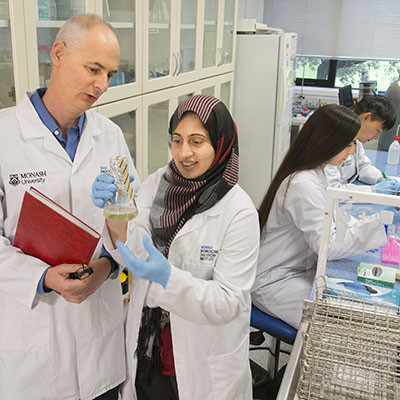
Monash University researchers have uncovered how a group of proteins perform like a ‘dimmer switch’, causing inflammation ranging from acute to chronic. This research has the potential to contribute to new treatments for inflammatory diseases including type 2 diabetes, atherosclerosis, heart attack and stroke.
The team from the newly established Monash Biomedicine Discovery Institute (BDI), in collaboration with the Monash Institute of Pharmaceutical Sciences (MIPS), uncovered a key aspect of the process of inflammation, involving chemokines — a group of proteins that are secreted into blood vessels — activating receptors in our white blood cells.
When white blood cells prolong their response to invading microorganisms, it can lead to disease. This process is a result of proteins known as chemokines activating receptors in the outer membranes of the white blood cells. It had been presumed that this reaction was like a simple on-off switch, but this latest research indicates that there are degrees of response caused by different chemokines.
It appears that the chemokines behave more like a dimmer switch, with stronger but briefer responses resulting in acute inflammation while longer, steadier responses can result in chronic inflammation.
Co-lead author Associate Professor Martin Stone said, “Until now, we did not understand how this was possible. Our work has identified the specific features of chemokines and receptors that are involved in their inflammatory activity.”
As these proteins are essential to all inflammatory diseases, these findings will have wide implications in a variety of settings. Associate Professor Stone, who heads a laboratory in the Infection and Immunity Program at the Monash BDI, stated, “The ultimate goal is to develop anti-inflammatory drugs that target these molecules.”
Associate Professor Stone presented the research at an international conference on cell signalling last week. It will appear in the journal Science Signaling and can be viewed at http://dx.doi.org/10.1126/scisignal.aai8529.
Could this 'nanobone' material allow children to regrow bone?
Australian scientists believe they have found an alternative to invasive bone graft procedures in...
The last mile of life sciences innovation
How do we translate technological possibility into meaningful real-world impact?
Machine learning uncovers patterns in DNA methylation
A new machine-learning method identifies differentially methylated DNA regions without sample...