Could this 'PFAS trap' remove the most difficult-to-capture variants from water?
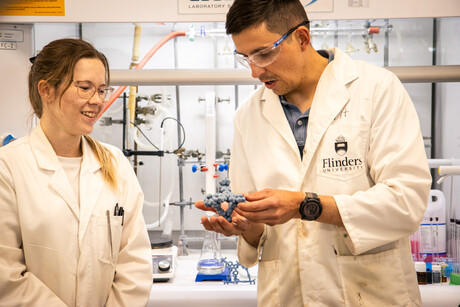
Flinders University scientists have showcased the use of a nano-sized molecular cage that acts as a highly selective ‘PFAS trap’.
Finding their way into fresh water as well as marine environments, perfluoroalkyl and polyfluoroalkyl substances (PFAS) from industrial manufacturing, aviation firefighting foam and consumer products are creating growing concerns about health risks to humans, livestock and wildlife — contaminating ground, surface and drinking water that affects millions of people worldwide.
Now, Flinders University researchers have discovered adsorbents that effectively capture PFAS, including short-chain forms that are especially difficult to remove using existing technologies. Funded by Australian Research Council grants, the study was published open access in Angewandte Chemie International Edition (doi.org/10.1002/anie.202526027) in February 2026.
“While some long-chain PFAS can be partially removed using existing water treatment technologies, the capture of short-chain PFAS — which are more mobile in water — remains a major unresolved challenge,” said project leader Dr Witold Bloch from Flinders’ College of Science and Engineering.
“We discovered that a nanosized cage captures short-chain PFAS by forcing them to aggregate favourably inside its cavity. This unusually strong binding mechanism is different from that of traditional adsorbent materials.”
As part of the study, the team embedded these molecular cages into mesoporous silica — an adsorbent that normally shows no PFAS binding properties. According to first author Caroline Andersson — a Flinders PhD candidate in chemistry — the presence of the embedded nanosized cage enables a broad range of PFAS to be removed from water, including short-chain variants that are notoriously difficult to isolate.
“The most exciting aspect of this project was that we first conducted in-depth studies of how PFAS bind within the cage on the molecular level,” Andersson said. “That allowed us to understand the precise binding behaviour and then use that knowledge to design an effective adsorbent for PFAS removal.”
Through laboratory testing it was shown that the adsorbent material can remove up to 98% of PFAS at environmentally relevant concentrations in model tap water. “The adsorbent also demonstrated reusability, remaining highly effective after at least five cycles of reuse,” Bloch explained.
“These results highlight its potential for integration into water filtration systems for polishing drinking water at the final stage of treatment.” Bloch concluded: “This research represents an important step toward the development of advanced materials capable of tackling one of the world’s most persistent environmental contaminants.”
Facilities used for the study included the MX1 and MX2 beamline at the ANSTO Australian Synchrotron, Australian Cancer Research Foundation detector, Flinders Analytical, Flinders Deepthought and the National Facility of the National Computational Infrastructure, and Microscopy Australia, enabled by NCRIS and the Government of South Australia at Flinders Microscopy and Microanalysis.
Could this human tissue biobank find the cause of a bowel cancer surge?
In a new Australian biobank, lab comparisons of tissue donated by cancer patients will explore...
Microscopic life is mining decades-old toxic waste
At abandoned Flinders Ranges mines, stable radioactive and toxic metals are being turned into...
Dual-bubble approach achieves microplastic removal rates of over 90%
Using a combination of microbubbles and nanobubbles, Australian scientists have developed a...