Common carp relatives could help stop virus spreading
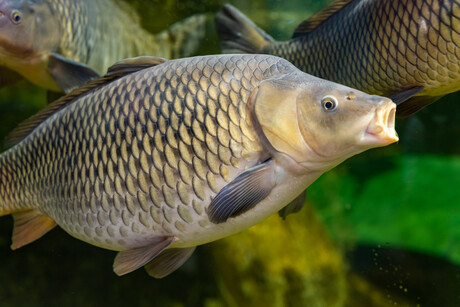
US and Israeli researchers have found that while common carp are highly vulnerable to a devastating virus, their close relatives can help stop its spread. Published in the journal Aquaculture, their work offers hope for fish farmers and freshwater ecosystems everywhere.
Common carp are among the world’s most widely farmed freshwater fish, providing food and livelihoods for millions of people. Unfortunately, they are threatened by koi herpesvirus (CyHV-3) — a highly contagious virus that is capable of wiping out entire populations in just days. Every outbreak can mean enormous economic losses and lasting damage to wild fish populations.
Now, researchers from The Hebrew University of Jerusalem and Michigan State University have discovered an unexpected piece of good news: while common carp are highly vulnerable to the virus, their close relatives including goldfish, grass carp, silver carp and black carp rarely become infected naturally, and are far less likely to pass it on to others.
"Because these fish often live alongside common carp in ponds and lakes, there has been concern that they might act as silent carriers of the virus,” said Professor Lior David of the Hebrew University of Jerusalem. “Our results show that, although they can occasionally become infected, they are actually very poor at spreading the disease.”
To demonstrate this, the researchers recreated how infections occur in the real world. Healthy fish were placed in tanks with infected common carp. While the virus spread rapidly among common carp, only a small fraction of the other carp species became infected, and almost none became ill.
The team then took the experiment one step further, injecting the virus directly into the fish to bypass their natural defences. Even then, the differences remained striking. Unlike common carp, which developed severe disease, the other species rapidly cleared the virus from their bodies and showed little sign of illness.
Finally, the researchers asked whether these healthy-looking fish spread the virus back to common carp. The answer was yes — but compared with infected common carp, the other species transmitted the virus much less effectively, making them what the study authors describe as “inefficient carrier hosts”. This matters because common carp, grass carp and silver carp remain among the world’s most important farmed fish, supplying food to billions of people and supporting aquaculture industries across Asia, Europe, and the Middle East.
The findings thus offer a hopeful new perspective on managing one of the most damaging diseases in carp aquaculture. By revealing how closely related fish species resist infection and limit transmission, the study could help researchers and fish farmers better understand — and ultimately reduce — the risk of future outbreaks.
Rapid blood test can detect iron deficiency in minutes
Scientists have developed a blood test that can detect iron deficiency in just 15 minutes,...
Prostate cancer therapy aims for first-in-human clinical studies in 2027
UniQuest, the commercialisation company of UQ, has entered into an exclusive licence agreement...
Museum specimens support future biodiversity monitoring
An eDNA library has been created using museum specimens and genomic data from fish monitoring...