Coin-sized sensor tracks stress in plants
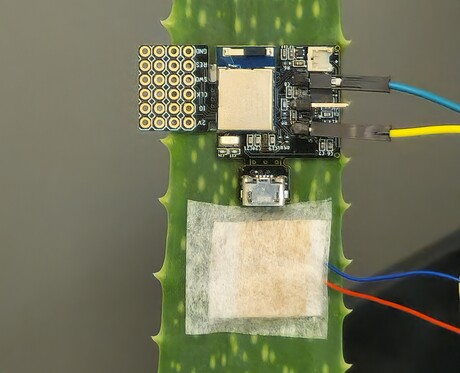
Researchers at the King Abdullah University of Science and Technology (KAUST) have developed a coin-sized device that attaches directly to plants to track how they respond to stressors such as drought and fires in real time. Described in the journal Cell Reports Physical Science, the device could one day help farmers know when their plants are stressed out.
The research hinges on a small but important molecule: hydrogen peroxide. Plants naturally produce small quantities of hydrogen peroxide throughout the day, with the molecule sending signals that help plants activate their defences against pathogens such as fungi and bacteria.
When plants are exposed to stressful conditions, such as too much heat or light, their cells can produce a surge of hydrogen peroxide. At high doses, the molecule damages plant tissues and may cause other problems. But monitoring hydrogen peroxide levels in plants has proved tricky for scientists — at least, without causing damage by collecting pieces from plants.
Seeking a way to better understand how plants respond to their environment, researchers at KAUST used a laser to create a sensor for hydrogen peroxide made out of graphene. The sensor sits in a device that is about the size of a small coin and rests on top of plant leaves. The device features needles that can suck up small amounts of fluid from inside the leaves; these needles are so tiny (just 0.4 mm wide) that they don’t cause the plants any serious injuries.
In a series of experiments, the researchers attached the devices to aloe vera plants growing in a greenhouse. Then, they shone especially bright lights on some of the plants.
At normal growing temperatures, or around 19°C, hydrogen peroxide levels in the plants began to spike almost immediately after the team turned on the bright lights. That surge was even more severe at hotter growing temperatures, or 28°C. In both cases, the hydrogen peroxide levels declined after about an hour.
The device could open the door to real-time insights on the inner workings of plants with an unprecedented level of detail, although the team still has to testing their design on a range of different plant species before it will be available for use by farmers. According to the authors, the discovery that plants react so much to changes in temperature and light could be a problem for many important species as the planet’s climate changes and heatwaves grow more common.
“Our research moves plant-health monitoring toward direct measurement of physiological stress signals, rather than relying only on visible symptoms or external environmental conditions,” said Mufeeda Mundummal, first author on the study.
“For Saudi Arabia and other arid regions, where agricultural production is strongly influenced by high temperatures and limited water resources, technologies that improve our understanding of plant stress responses could be especially valuable.”
Colour-changing material could help combat counterfeiting
Researchers have developed a material that changes colour in the near-infrared region, meaning...
Reinforced ice is stronger and harder to shatter
Researchers have found a way to reinforce ice with tiny plant-based crystals and a specially...
Fingertip sensor identifies physical patterns linked to anxiety
An international study has provided early evidence that mental distress may be accompanied by...