Repairing blood vessels to improve anticancer treatment
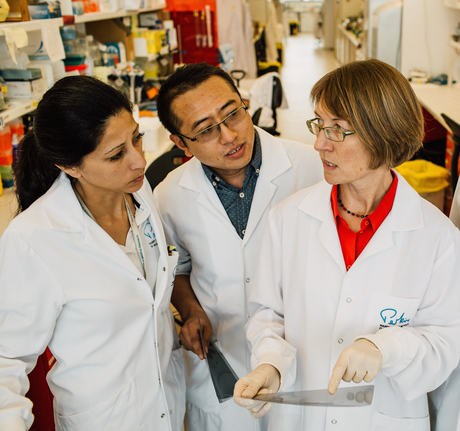
A new drug developed at the Harry Perkins Institute of Medical Research could be used to repair the blood vessel defects that prevent current anticancer treatments from entering tumours.
Tumours require a lot of nutrients, so surrounding blood vessels are redirected towards the cancer and ultimately develop abnormalities. As a result, anticancer treatments like chemotherapy and immunotherapy can struggle to enter these tumours.
While investigating this problem, Professor Ruth Ganss and her team in the Perkins Vascular Biology and Stromal Targeting Laboratory found that the smooth muscle cells that line blood vessels, giving them shape and helping them pump blood, often break down in tumours. Once the smooth muscle cells break down the blood vessel becomes leaky, reducing blood flow and preventing chemotherapy and immune cells travelling into the tumour.
The researchers have since developed a drug that repairs these smooth muscle cells and returns normal blood flow to the vessels, allowing other anticancer drugs to reach the tumours’ core. Their work has been published in the journal Cell Reports.
“To achieve greater absorption of anticancer drugs, the blood vessels are really key,” Professor Ganss said.
Professor Ganss further believes that the defect in smooth muscle cells lining blood vessels in cancer could be a catalyst for other problems. She suggested, “It could be that once the smooth muscle cells break down and the blood vessels become leaky, cancer cells are able to slip out of the tumours and migrate through the blood stream to spread to different parts of the body.”
The team is currently investigating whether the new drug could help stem the spread of cancer in a patient by repairing the leaky blood vessels.
Scientists uncover how cancer cells hide from immune system
By targeting the RNA helicase known as DDX6, scientists could enable the immune system to...
Vanillin flavouring in vapes may disrupt embryo development
Vanillin — a common flavouring chemical in e-cigarettes — may disrupt the normal...
Heart valve tissues created from stem cells
The breakthrough should help advance our understanding into how human heart valves develop,...